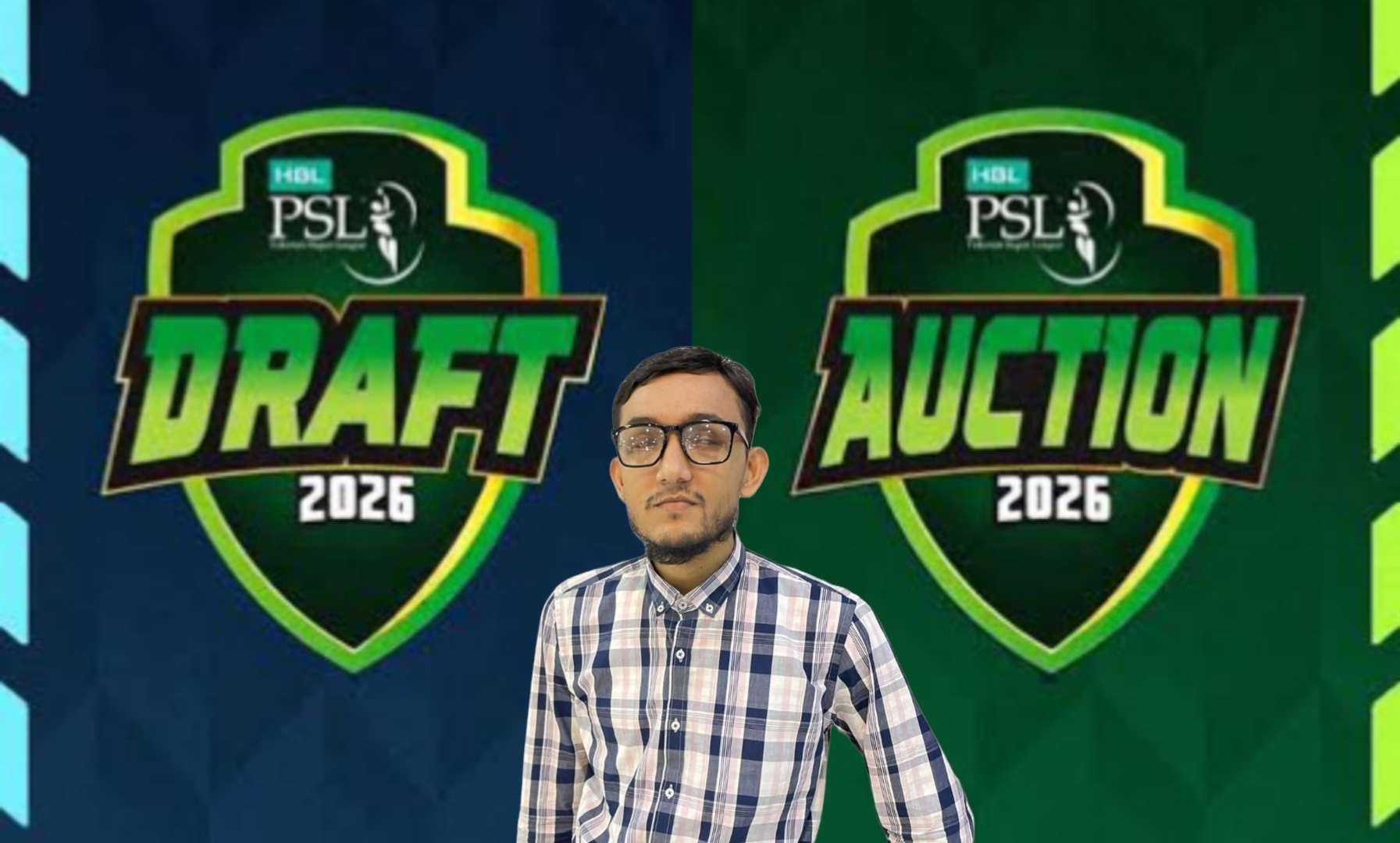
PSL Draft vs Auction Debate
PSL Draft vs Auction Debate: Salman Naseer Reveals Franchise Divide as Pakistan’s Blind Sports Journalist Muhammad Areeb Uddin Sheikh shares indepth analysis
The Draft vs Auction debate in the Pakistan Super League (PSL) has intensified as the league completes a decade and moves toward expansion. PSL CEO Salman Naseer, speaking to the media, laid out the deep divide among franchises, exposing two contrasting visions for the league’s future. His remarks have triggered strong reactions from Pakistan’s first blind sports journalist, Mohammed Areeb Uddin Sheikh, who has criticised the anti-auction franchises for resisting progress and slowing PSL’s evolution.
Salman Naseer Highlights Clear Franchise Divide
Salman Naseer clarified that PSL management wants to increase the player purse beyond USD 1.3 million and is open to adopting a new model — whether auction, hybrid, or a modernised draft. However, he emphasised that no decision can be finalised because franchises are not unanimous.
Some franchises prefer sticking with the draft system. Their argument, as relayed by Salman Naseer, is that drafts allow teams to build balanced squads within controlled budgets. They believe category-based drafting prevents overspending and keeps teams competitive, whereas an auction could inflate prices beyond sustainable levels.
These franchises also argue that if “good players” are already available at low cost, then increasing the purse is unnecessary. Salman Naseer made it clear that this thinking comes from certain franchises and does not reflect PSL management’s own stance.
Another layer of resistance, according to Salman Naseer, comes from emotional attachment. Some franchises have invested in certain players for years and believe an auction would disrupt team identity and weaken fan connection.
At the same time, Salman Naseer confirmed that the divide is not evenly split. A majority of franchises want financial enhancement — including increased purse and openness to an auction-based model. PSL management itself is aligned with this progressive direction and sees it as essential for attracting elite international players and strengthening the league’s global standing.
Mohammed Areeb Uddin Sheikh: PCB’s Vision Must Be Recognised
Mohammed Areeb Uddin Sheikh, Pakistan’s first blind sports journalist and ICC/PCB accredited media professional, stressed the need to give credit where it is due. He noted that PCB Chairman Mohsin Naqvi, PSL CEO Salman Naseer, and PSL management have played a crucial role in elevating the league globally. According to Sheikh, the international roadshows were not symbolic; they were strategic efforts that successfully attracted overseas investors and enhanced PSL’s credibility worldwide.
Sheikh emphasises that the arrival of new overseas-backed teams is a result of years of planning, branding, and presentation — not the achievement of local franchises. He argues that the structural progress of PSL is driven by management vision, not franchise politics.
Why Anti-Auction Franchises Are a Roadblock to PSL’s Growth.
According to Mohammed Areeb Uddin Sheikh, franchises resisting auctions are not simply offering an alternative viewpoint; they are actively obstructing PSL’s advancement.
He states that globally, major leagues—IPL, BPL, SA20, ILT20, Lanka Premier League, and even now The Hundred, which is moving towards player auctions this March—rely on auctions or open-market systems for fair valuation, transparency, and competitive balance.
Among these, only the IPL was operating before the Pakistan Super League, while all the other leagues emerged after the PSL and have already shifted to player auctions, offering significantly higher payments than PSL, Meanwhile, we are still stuck with the draft system.
The argument that drafts maintain balance while auctions damage it is, in his words, “not rooted in data or modern sports governance.”
Sheikh explains that the draft system artificially inflates some salaries and suppresses others. Emerging players are stuck at low pay levels regardless of performance, while some higher-category players do not justify the price forced by draft rules. In contrast, auctions ensure players receive true market value based on demand and supply.
Structural Flaws in the Current Draft System
Sheikh argues that while the draft served a purpose in PSL’s early years, its limitations are now glaring. Category rigidity forces teams to use wildcards unnecessarily. The scarcity of top-tier local players leads to hoarding, and teams are compelled to pick lower-impact players at inflated prices just to meet draft requirements.
This structural imbalance results in misrepresentation of player value — something auctions inherently correct.
Professional Capacity Gaps Within Certain Franchises
Mohammed Areeb Uddin Sheikh addresses an uncomfortable reality: several franchises lack professional infrastructure. These franchises struggle with basic media relations, fail to communicate with journalists, mishandle press sessions, and often send unprepared representatives to official engagements.
Sheikh argues that franchises unable to manage communication, analysis, or strategy are not equipped to dictate league-wide decisions about auction systems. The resistance to auctions stems, in his view, from fear — because auctions require preparation, valuation expertise, and accountability, whereas drafts allow shortcuts.
“Draft Equals Balance” — A Weak and Outdated Argument
Sheikh dismisses the claim that drafts alone ensure balanced squads. He states that balance comes from planning, not from the system. In auction-based leagues worldwide, well-managed teams consistently build competitive squads through preparation and analytics.
By insisting the draft guarantees balance, franchises expose their own limitations, he argues. Instead of raising their professional standards, they cling to outdated systems for comfort.
Franchises Choosing Convenience Over Progress
Sheikh states that franchises opposing auctions and higher purses are prioritising short-term comfort over PSL’s long-term growth. They benefit from low salaries, low competition, and minimal accountability — but the league as a whole suffers.
He stresses that while some franchises like Lahore Qalandars and Peshawar Zalmi do contribute positively through player development and planning, many others remain inactive for most of the year, only appearing shortly before the league begins. This inconsistency reflects structural weakness and lack of commitment to year-round professionalism.
Auction Requires Serious Work — and Some Franchises Are Avoiding It
According to Sheikh, auctions require analysts, scouting networks, valuation models, financial planning, and quick decision-making — resources many franchises currently lack. Their resistance is not philosophical; it is practical. They oppose auction because it demands effort they are not prepared to make.
Voting Pattern Exposes the Real Divide
Sheikh points out that among the original six PSL franchises, three now support auctions and purse increases, while three strongly oppose both. The two new incoming franchises also support auctions. This means resistance comes from a shrinking minority — not the league as a whole.
Stagnation Is the Real Threat to PSL
For Sheikh, the biggest danger facing PSL is not debate — it is stagnation. Franchises that resist spending, oppose auctions, and promote second-tier players as “good enough” are obstructing PSL’s ability to compete globally and attract top-tier international stars.
He asserts that after 10 years, PSL must modernize. Auction is no longer optional; it is necessary. Currently, the PSL is being organized in the IPL window, and at present, players who do not participate in the IPL are available and can join the PSL, allowing the league to attract good talent. However, if the PSL returns to its original February-March window and remains under the draft system, players will know that the pay is lower, making it harder to attract top international players. Many of these players, who currently join the PSL because IPL conflicts free up their schedule, may no longer participate. Moving to an auction system is crucial because it allows the league to offer competitive pay, increases players’ interest, and encourages them to register themselves. The auction provides flexibility, proper player valuation, and a stronger mechanism to attract elite talent, ensuring that the PSL can grow, remain competitive, and successfully bring top international players to the league even in its original window.
Conclusion: Vision vs Stagnation
In conclusion, Mohammed Areeb Uddin Sheikh states that the Draft vs Auction debate is no longer technical — it is ideological. Salman Naseer’s statements have exposed the divide: one side wants progress, higher investment, and global competitiveness; the other clings to outdated systems for comfort and minimal effort.
Sheikh firmly argues that PSL must adopt an auction model, increase the purse, allow reasonable retentions, and move beyond emotional attachment. Without modernization, PSL will remain stuck in a decade-old cycle.
If PSL truly intends to become a global brand, it must prioritise professionalism, market-driven valuation, and structural evolution over fear, convenience, and resistance from unprepared franchises.
